
MUSE RADAR / EVENT BRIEF
Jira and Confluence Can Bring Context Into ChatGPT and Codex—Choose the Right Path
OpenAI and Atlassian expanded their partnership on October 6 and documented four practical routes: Atlassian MCP in ChatGPT or Codex, Jira-to-Codex deeplinks, and OpenAI model choice in Rovo Agents. Plans, permissions and data handling differ, so begin with read-only retrieval.
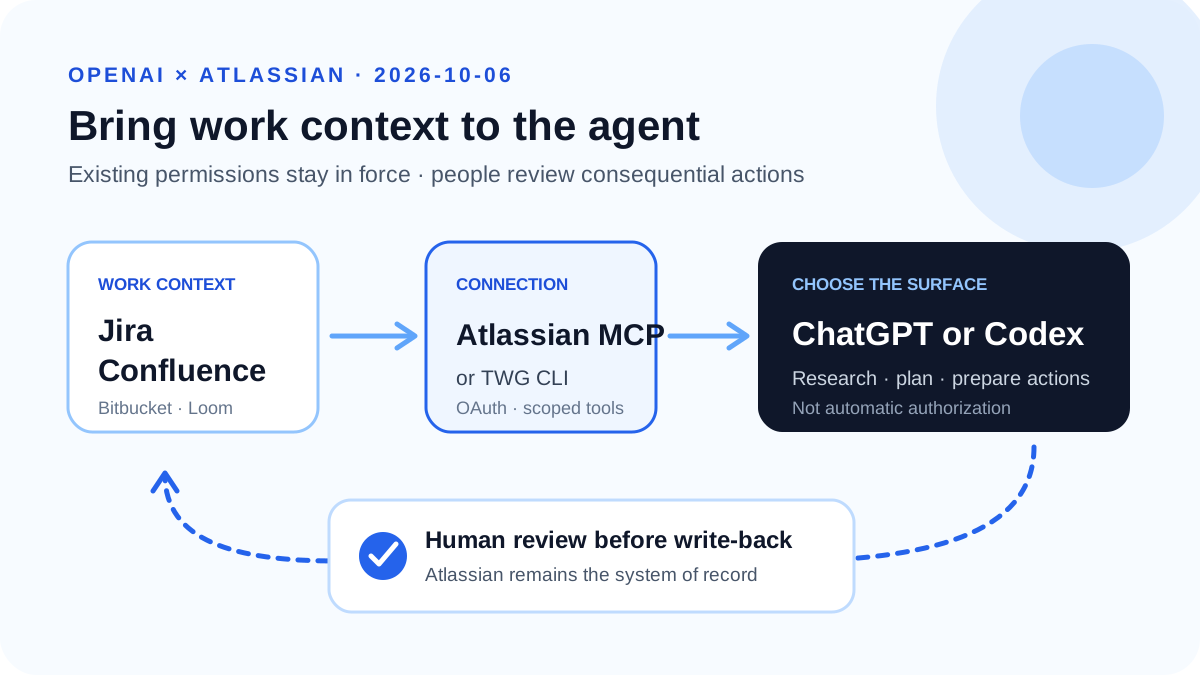
This is four integration paths, not one universal switch
OpenAI announced an expanded Atlassian partnership on October 6. The joint implementation guide describes four routes: Atlassian MCP for Jira, Confluence, Bitbucket and Loom in ChatGPT; Atlassian context inside Codex; a Jira work-item deeplink into Codex; and OpenAI model selection for Rovo Agents.
Teamwork Graph supplies organizational context, a model prepares analysis or actions, and Atlassian remains the system of record. The entry point, entitlement and processing terms differ, so these integrations should not be treated as one permission set.
ChatGPT and Codex have different prerequisites
Atlassian says its ChatGPT connector currently requires ChatGPT Team or Enterprise with developer mode, access to the relevant Atlassian Cloud products and any administrator approval required by policy. It works in standard chat, Deep Research and Agent mode, while every tool call remains limited by the user's existing Atlassian permissions.
The Codex route requires Codex on a paid ChatGPT plan plus a CLI or IDE extension with MCP support. Developers also need repository access and permission to the relevant Jira or Confluence content. Teamwork Graph CLI is an alternative for terminal and CI/CD workflows; it complements MCP rather than being a mandatory second installation.
Validate one read-only requirement check before enabling writes
A bounded first task is to let Codex read one Jira item and its linked architecture decision, then draft an implementation plan for the current repository without changing code or writing back to Jira. Review the requirements, citations and omissions before separating code changes, status updates or comments into individually approved steps.
High-impact actions can be reviewed before execution, but that does not make every write inherently safe. Administrators should also inspect Atlassian MCP controls, OpenAI plan terms, audit history and prompt-injection exposure from external content. Our MCP, connectors, privacy and activity-log guides cover those checks separately.
Processing terms depend on which side initiates the work
When Atlassian content is sent to ChatGPT or Codex, the organization's OpenAI plan and terms govern OpenAI-side processing. OpenAI models used inside Atlassian-managed Rovo experiences follow a different product and contract path. Review retention, region, administrator policy and model availability for the chosen route before rollout.
This edition verifies the documented connection methods and prerequisites. It does not claim every customer has automatic access, and it does not present OpenAI's statement that more than 3,000 Atlassian developers use Codex as MuseVIP testing or proof of outcomes.
Source notes
Event date and our publication date are shown separately. Community reports describe individual experiences.