
MUSE RADAR / EVENT BRIEF
Google Shuts Down the Older Antigravity Agent Preview: Local Tooling Needs a Real Migration
Google announced the migration on September 17 and set October 5 as the shutdown date for antigravity-preview-05-2026. Apps that only read hosted-sandbox output can usually change the agent string; local tools and function_call parsers also need schema and file-edit updates.
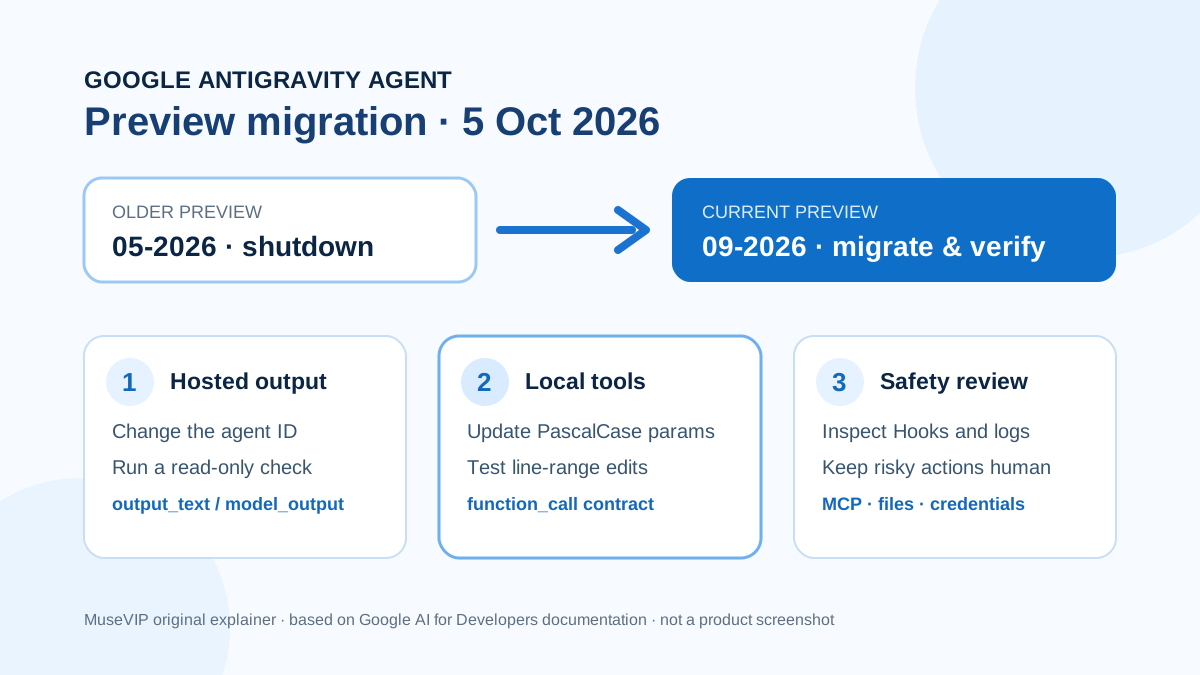
Today's event is the older preview shutting down
Google released antigravity-preview-09-2026 on September 17 and announced that antigravity-preview-05-2026 would shut down on October 5. We record October 5 as the effective event date and preserve September 17 as the announcement date instead of presenting an older notice as a new launch.
The replacement is still a preview and Google has not announced its shutdown date. Treat this as the deadline to migrate and run regression tests, not as a promise that the interface is generally available or frozen.
Hosted output may need an ID swap; local tooling needs more
For tasks in Google's remote environment where the application reads only output_text or model_output, the official guidance says changing the agent string to antigravity-preview-09-2026 is normally enough. Run a read-only staging task first and verify output parsing, cost records and timeout handling.
Applications using local_environment or parsing function_call steps face breaking tool-contract changes. Built-in parameters move from snake_case to PascalCase; file edits move from whole-file rewrites to replacements with StartLine and EndLine; list_files becomes list_dir; and native name and grep searches are added. Keep fixtures for both the old and new contracts while migrating.
Recheck the tool boundary instead of assuming a universal browser agent
The current Antigravity Agent can execute code, manage files and search the web in a Google-hosted isolated Linux sandbox. It can also use custom functions, remote MCP servers and synchronous Hooks. Google's documented limits still exclude computer_use, file_search and Google Maps; remote MCP supports Streamable HTTP rather than SSE, and server names must be lowercase alphanumeric.
Turn those boundaries into tests: begin with read-only search, then read a file and make one small edit in a disposable sandbox, and finally inspect function calls, Hook decisions and activity logs. Keep a person in the loop for production files, credentials and external sends.
A practical migration sequence
Save three to five representative tasks and their tool calls, switch the agent ID in staging, then test hosted output, local parameters, line-range edits and failure retries separately. Move production traffic gradually only after both output and side effects match expectations. Do not use a live production directory for the first file-edit test.
Use our MCP setup guide to verify transport and permissions, the ongoing-task guide to define migration checkpoints, the activity-log guide to inspect calls and the prompt-injection guide to review untrusted web and tool output. We found no independently verifiable community test from the last 72 hours, so no forum anecdote is presented as a general result.
Source notes
Event date and our publication date are shown separately. Community reports describe individual experiences.